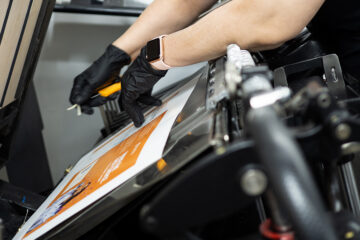
Digital printing has come a long way in just a few decades. From early laser technology and the rise of inkjet printing to the desktop publishing boom, the industry shifted rapidly from plates to pixels. Today, digital printing is one of the most flexible and efficient ways to produce high-quality print, especially for short runs, fast turnaround, and modern business marketing materials.
Between the 1970s and 1990s, the printing world underwent one of its most dramatic transformations. Digital printing was on the rise thanks to impressive technological advances like laser, inkjet, and desktop publishing. The outcome of this transformation? A whole new era that changed how we create, prepare, and produce printed materials. But how did these technologies evolve, and why does it matter?
One Small Step for Laser, One Giant Leap for Printing
In 1969, American engineer Gary Starkweather came up with the idea of using a laser beam to “draw” an image directly onto a printer’s copier drum. The drum would then selectively collect electrically charged powdered ink (toner) to transfer the image to paper and then heat it to permanently fuse the text and imagery to the paper.
By 1976, the first commercial laser printer, the IBM 3800, was released. Designed for data centres, it replaced line printers that were attached to mainframe computers. It was so effective at high-volume printing (achieving speeds of 215 pages per minute at a resolution of 240 dots per inch), that over 8000 of these printers were sold.

While these early versions of laser printers were large, expensive, and mainly used for specialist applications, word was quickly spreading about this all-new tech and its potential in the printing industry.
FUN FACT: Gary Starkweather also invented colour management technology in the 1990s at Apple Computers and was a digital effect consultant for Star Wars (1977)! He won an Academy Award in 1994 for his pioneering work with Lucasfilm (and later, Pixar) in the field of colour film scanning.
Colour Me Impressed
By the 1980s, consumer inkjet printers emerged on the scene. Capable of producing prints that could rival photographs developed in a darkroom, they became widely popular in office and industrial spaces, as well as at home. While many companies raced to be the top of the market, it was Hewlett-Packard (HP), Canon, and Epson that refined inkjet technology and revolutionized the industry.

Using the drop-on-demand (DOD) method, their inkjet printers used precise electronic signals to eject individual ink droplets only when needed. This not only reduced waste but also made the technology more affordable. It also challenged older technologies by simplifying access to colour printing.
Suddenly, more businesses could integrate in-house colour output or short-run jobs compared to the large traditional offset runs. The print world became a whole lot more colourful.
FUN FACT: The earliest experiments with inkjet technology go all the way back to the 19th century. In 1867, Lord Kelvin patented a continuous inkjet (CIJ) device called the syphon recorder. Used for ship navigation, it recorded telegraph signals as a continuous trace on paper. It did this by deflecting an inkjet nozzle using a magnetic coil.
Power to the Designer
As advancements in printing devices continued, so did computing software. Personal computers, such as the Apple Macintosh, and layout software like Aldus PageMaker opened new doors to create professional-quality documents in smaller studios.
Before desktop publishing, most typed documents were created on a typewriter. Options were limited, with only a few typefaces and minimal font sizing. Once people could design page layouts on a screen and print text and graphics at up to 300dpi, the traditional publishing industry changed dramatically.
These print-ready files could then be sent directly to a printer. This significantly reduced the time and cost from concept to print. Newspapers and other print publications quickly adopted desktop publishing programs in the early 1980s. For printing businesses everywhere, it meant greater flexibility, faster turnaround times, and a major shift in how clients approached print.
FUN FACT: Paul Brainerd, co-founder of the publishing/printing software company Aldus, originally coined the term “desktop publishing”. He was looking for a marketable catchphrase to describe the small size and affordability of Aldus’s suite of products. While at first it was used exclusively for print publications, today desktop publishing also assists in the creation of various forms of online content.
The First True Digital Press is Born
In 1993, the printing industry shifted once again when Indigo Digital Printing introduced the E-Print 1000, a sheet-fed colour digital press that could compete with offset printers for short runs. Without the need for printing plates, job setup became faster, changeovers simpler, and on-demand print jobs a whole lot more viable.

Digital printing has undeniably changed the world of print. It’s used everywhere, from home offices and artists to small businesses and global corporations. It also gives creators more control from design to final output. Printing has come a long way since the 1400s, and the pace of innovation has only accelerated since 1993. With new techniques like UV printing and environmentally friendly inks, the industry continues to evolve every day.
FUN FACT: The printing press was invented by German inventory Johannes Gutenberg around 1439. The Gutenberg style printing press could output around 240 pages per hour. Today, digital presses can operate at speeds of 300 pages per minute!
Digital Printing Today
Digital printing has become the go-to option for businesses that want professional results without long lead times or large minimum quantities. Modern digital presses produce everything from business cards, brochures, flyers, postcards, booklets, and posters with sharp detail and vibrant colour.

Bond Reproductions
At Bond Reproductions, we provide digital printing services in Vancouver for short-run projects and fast turnaround. We also offer variable data printing, so you can personalize materials with names, versions, or QR codes. Digital printing makes it easy to update files, print on demand, and reduce waste compared to traditional large-run methods.
Whether you’re creating marketing materials for a campaign, printing internal documents, or updating branded collateral, digital printing gives you a fast, flexible solution with consistent quality.
FAQs
What types of products can be made with digital printing today?
Digital printing is commonly used for business cards, brochures, flyers, postcards, posters, booklets, and other marketing materials. Modern digital presses can produce sharp text, vibrant colour, and consistent results across a wide range of print products.
Why do Vancouver businesses choose digital printing for short runs?
Many businesses choose digital printing because it offers quick turnaround and flexibility without requiring large minimum quantities. It’s ideal for small-to-medium print orders, marketing campaigns, and projects that need frequent updates or multiple versions.
Can digital printing be personalized with names, QR codes, or multiple versions?
Yes. Digital printing supports variable data printing, which allows personalized details like names, addresses, QR codes, or unique versions within the same print run. This makes it a great option for direct mail, event materials, and targeted marketing campaigns.
Looking for a trusted digital print shop in Vancouver? Bond Reproductions can help with short-run printing, quick turnaround, and variable data options. Contact Us to get started.