The Evolution of Color: Ancient Pigments to Modern Offset Inks
The history of ink and pigments is stranger than fiction. Artists once painted with Mummy Brown, a pigment literally made by grinding up Egyptian mummies, and Cochineal Red, a brilliant scarlet dye made from crushed insects. These unusual pigments were treasured for their beauty, but they were costly, unstable, and sometimes even toxic.
Today, things look very different. Modern offset printing uses safe, stable CMYK inks (cyan, magenta, yellow, and black) that combine to reproduce millions of colours with precision and consistency.

The Risks and Rarities of Historic Pigments
From luxury to toxicity: why old pigments weren’t built for print
The pigments in collections like Harvard’s Forbes Pigment Collection show just how far ink and colour have come. Ultramarine, once made from lapis lazuli, was so rare it cost more than gold and was reserved for sacred works of art. Emerald green, used in 19th-century wallpapers and paintings, was laced with arsenic and poisoned those who lived with it. Vermilion, a brilliant red made from mercury, carried its own health hazards.
These pigments may have been beautiful, but they were expensive, unstable, and unsafe. More importantly, they weren’t practical for the demands of large-scale printing, where consistency, safety, and availability are essential.
The Rise of Ink in Large-Scale Printing
From Gutenberg’s varnish to modern offset formulations

When Johannes Gutenberg introduced the movable-type press in the 15th century, he needed something stronger than the water-based inks used for handwriting. He created a thick, oil-based ink made from lamp black (soot) mixed with linseed oil, walnut oil, turpentine, and resin. This durable formula made mass printing possible and helped launch the Printing Revolution.
By the Industrial Revolution, printing required inks that could keep up with faster presses and bigger runs. Artisanal recipes gave way to engineered blends that offered consistent colour, faster drying, and higher output.
Modern offset inks are built with three main components:
- Pigments (15–25%): Provide colour and opacity
- Varnish or vehicle (50–70%): Oils and resins that carry pigments and set on paper
- Additives (5–15%): Driers, waxes, and other agents that control drying speed, gloss, and resistance
These carefully balanced formulas give offset printing its reputation for sharp detail, vibrant colour, and reliable performance across large volumes.
The Inks Behind Bond’s Offset Printing
Safe, sustainable, and engineered for consistency
Unlike the rare or hazardous pigments of the past, modern offset inks are designed to deliver both safety and performance. At Bond, we use the CMYK process (cyan, magenta, yellow, and black) which allows millions of color combinations to be reproduced with precision and clarity.
Our inks combine carbon-based organic pigments (for rich, bright tones) with safe inorganic compounds such as titanium dioxide for opacity and carbon black for deep, sharp text. Many of our inks are also soy – or vegetable-based, which lowers emissions and makes recycling easier by reducing the environmental impact of de-inking during paper processing.
This approach ensures:
- Reliable colour accuracy across every project
- Consistent quality on large print runs
- Eco-friendly printing options that align with the values of businesses and communities across BC
When paired with high-quality paper stocks and specialty finishes like foiling or embossing, Bond’s offset inks provide the foundation for materials that are professional, long-lasting, and sustainable.
Why Bond’s Offset Printing Delivers When It Counts
High-quality, flexible, and built for volume
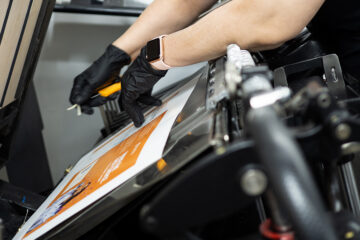
Offset printing has been a reliable workhorse in the print world for over a century. At Bond, we pair this time-tested process with state-of-the-art Heidelberg equipment to offer unmatched efficiency and consistent quality.
Ready to bring your next project to life (without crushed mollusks or sea snails)?

Discover how Bond’s offset printing delivers the quality, consistency, and scale your business needs.
Contact our team today to get started.